

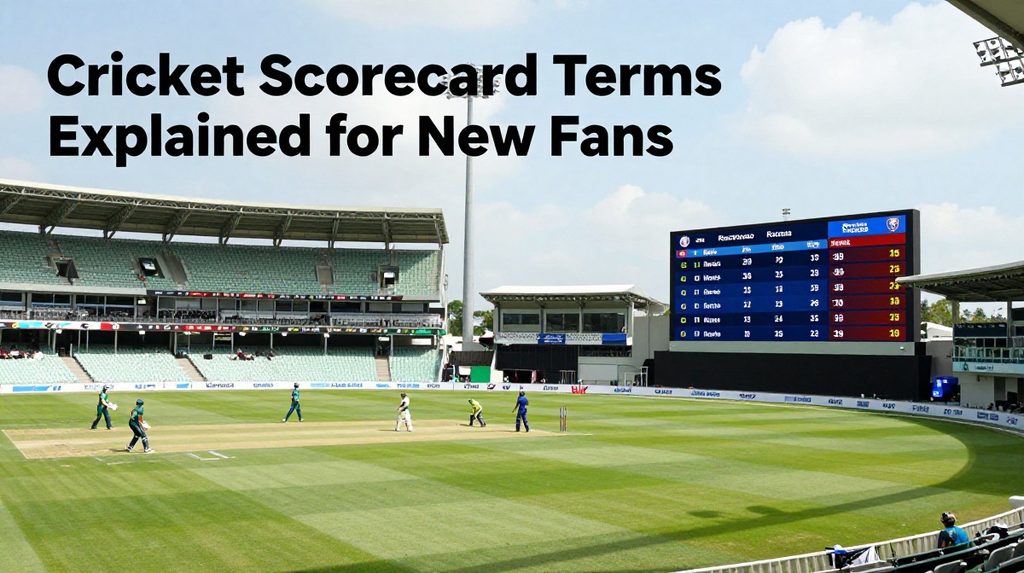
Picture this. You are watching India vs Australia on your phone. The Cricbuzz scorecard shows India: 187/4 (34.2 Ov) | RR: 5.46 and your friend is excited. You nod along, but honestly? You have no idea what half of that means.
You are not alone. Millions of new cricket fans in India open a scorecard every day and feel the same way. The good news is that once you understand the basic layout, everything starts making sense fast. This guide walks you through a scorecard section by section, the way you would explain it to a younger sibling.
What Does the Score Like 187/4 Actually Mean?
The two numbers separated by a slash are the heart of everything you see on a scorecard.
The first number 187 is the runs scored by the batting team. The second number 4 is the wickets they have lost. Since a team has 11 players and needs two batters on the field at all times, an innings ends when 10 wickets fall. So 4 wickets lost means six wickets are still in hand.
The numbers in brackets, 34.2 Ov, tell you how many overs have been bowled. 34.2 means 34 complete overs and 2 balls of the 35th over. And RR: 5.46 is the run rate, meaning the team is scoring an average of 5.46 runs per over.
Reading the Batting Section of a Cricket Scorecard
This is where each batter’s performance is listed. Open a live Cricbuzz scorecard and you’ll see columns that look like this:
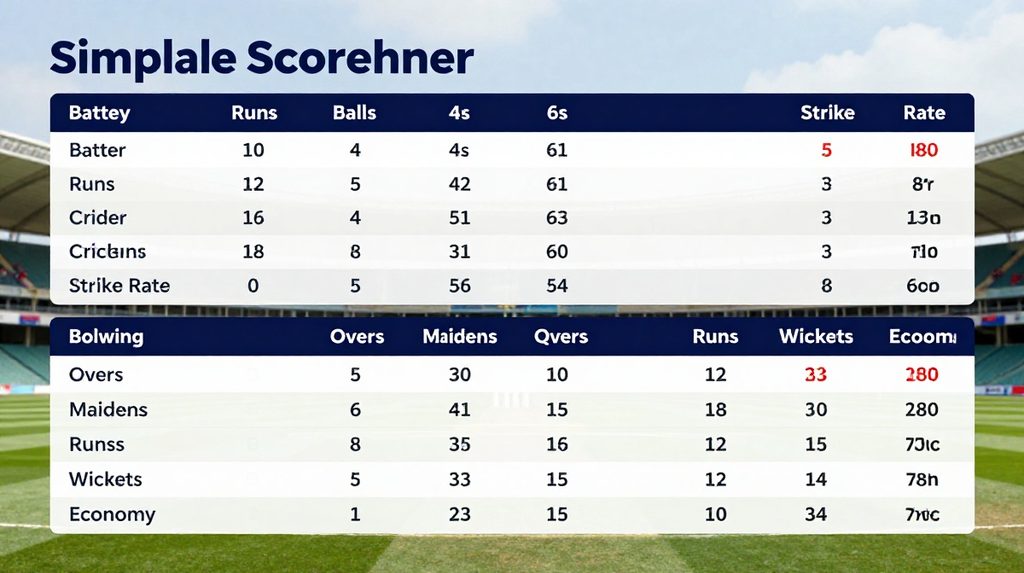
| Batter | How Out | R | B | 4s | 6s | SR |
|---|---|---|---|---|---|---|
| Rohit Sharma | c Warner b Starc | 72 | 58 | 8 | 3 | 124.13 |
| Shubman Gill* | not out | 45 | 40 | 4 | 1 | 112.50 |
Here is what each column means:
R (Runs): The total runs that batter scored.
B (Balls): The number of balls they faced. This matters because a batter who scores 50 off 30 balls is far more valuable in a T20 than one who scores 50 off 70.
4s and 6s: The count of boundaries (fours) and sixes they hit. It tells you how they scored their runs.
SR (Strike Rate): This is runs scored per 100 balls faced. A strike rate of 124.13 means the batter scored 124 runs for every 100 balls. In T20 cricket, anything above 140 is considered aggressive. In Tests, even 50 can be perfectly fine.
The asterisk : When you see a next to a batter’s name or score, it means they are not out. Shubman Gill means he is still batting when the innings ended or is currently at the crease.
How Out column: This tells you the mode of dismissal. c Warner b Starc means Rohit was caught by David Warner off the bowling of Mitchell Starc. Common dismissal codes include:
- b bowled, c caught, lbw leg before wicket, st stumped, run out
The Bowling Section and What All Those Numbers Mean
Scroll past the batting section and you will find the bowling scorecard. This is where cricket scorecard terms often confuse new fans the most.
| Bowler | O | M | R | W | Econ |
|---|---|---|---|---|---|
| Jasprit Bumrah | 10 | 1 | 42 | 3 | 4.20 |
| Kuldeep Yadav | 10 | 0 | 56 | 2 | 5.60 |
O (Overs): How many overs that bowler bowled.
M (Maiden Overs): This is a column many new fans skip over. A maiden over is an over in which the bowler gives away zero runs. In T20s, a maiden is rare and very impressive. It shows the bowler was so tight that the batters could not score at all in that over. Bumrah’s 1 maiden here tells you he had at least one completely dot-ball over.
R (Runs Conceded): Total runs scored off that bowler’s bowling.
W (Wickets): Total wickets taken. This, along with runs conceded, is how you judge a bowler’s success.
Econ (Economy Rate): Runs given per over. Bumrah’s economy of 4.20 is excellent in an ODI. Kuldeep’s 5.60 is decent but more expensive. In T20 cricket, an economy below 7 is generally considered good. For lotus365 win fantasy cricket users, economy rate and wickets are the two stats that affect your bowler’s fantasy points directly.
Extras, DNB, and Fall of Wickets
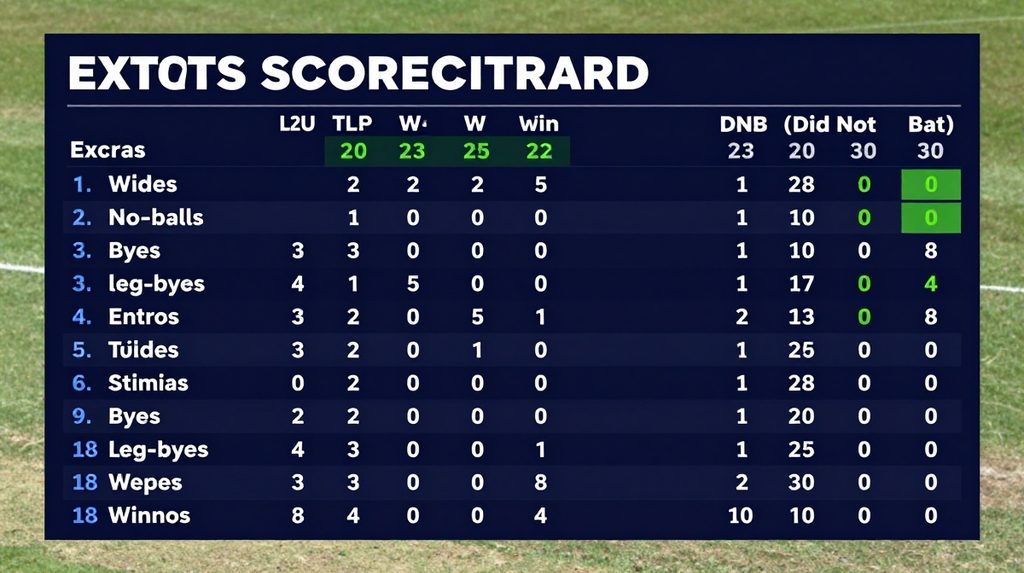
These three sections sit at the bottom of a batting innings, and most new fans scroll past them. They are actually quite revealing.
Extras: This line shows runs that were not scored by the batters directly. It has four parts b byes, where the ball passes the batter and the wicketkeeper and the fielding side fails to stop it, lb leg byes, runs taken off the body, w wides, when the bowler bowls outside the permitted area, and nb no-balls. A wide or a no-ball adds a free run and an extra delivery to the batting team. A high extras total, say above 15 in an ODI, shows the bowling side was sloppy.
DNB (Did Not Bat): You will see DNB: followed by a list of names. It means these players were in the team but never got a chance to bat because the innings ended before their turn. This is common in winning run chases.
FoW (Fall of Wickets): This row reads something like 1-46 Rohit, 8.2 ov, 2-88 Kohli, 16.4 ov. It tells you at what team score each wicket fell, and in which over. It lets you reconstruct the story of the innings without watching the highlights. If you see 5-190 over 42 and 6-192 over 43, you know two wickets fell in two consecutive overs, which is a mini collapse.
Other Common Cricket Scorecard Terms You Will Come Across
NRR (Net Run Rate): This appears in tournament standings, not individual scorecards. It is calculated as the average runs scored per over minus the average runs conceded per over across all matches. A positive NRR means a team has been performing better than their opponents on average. For platforms like lotus365 apk where fans track standings for fantasy picks, NRR becomes relevant when two teams are level on points.
D/L or DLS: If you see India won by 20 runs DLS method, it means rain interrupted the game and the target was recalculated. The Duckworth-Lewis-Stern method, adopted by the ICC, adjusts the chasing team’s target based on how many overs and wickets were lost due to the stoppage. It is the ICC’s official method for rain-interrupted limited-overs matches.
50 or 100 with a star: On Cricbuzz or ESPNcricinfo, when a batter reaches a milestone fifty or century, it is sometimes shown with a bold number or highlighted. The here still means not out at that score, not the milestone itself.